In Certain Cannabis Products, Thc Concentrations Can Be How High?
Introduction
In some states in the USA, the legalization of cannabis for adult and medical apply has increased the availability and sales of cannabis products, such as extracts, that take a THC content >70% (1). The cannabis manufacture has resisted proposals to cap THC content by arguing that people who use high potency cannabis extracts titrate their doses (eastward.g., reduce their THC dosage of higher potency cannabis products to achieve the same desired psychoactive effects). They may, for example, reduce the corporeality smoked when using high THC products. They may as well inhale smaller puffs or do so less often when using higher dominance products (2). The ability to do and then volition depend upon users understanding the relationship betwixt product say-so and their desired effects so that they tin can titrate their THC dose (3).
We systematically reviewed evidence on the degree to which people who use cannabis for recreational purposes can and do reduce their THC dose when using more stiff products.
Methods
Eligibility Criteria
We included original studies published from 1973 to the engagement of our search (17 June 2020) if they reported quantitative information on behavior indicative of titrating THC doses from cannabis products (via any route of administration) that varied in THC content (e.g., by varying or decision-making the corporeality rolled, inhaled, or consumed).
We excluded studies of medicinal cannabis use and clinical/pharmacological studies where patients/participants were instructed to titrate their dose of cannabis consumption. Our review aimed to examine prove on recreational cannabis use in non-supervised settings to better inform public health policy on the regulation of recreational cannabis utilize.
Search Strategy
The search was conducted in PubMed and Embase with terms related to "Cannabis" AND 'Titration' in the title/abstruse/related MeSH and Emtree explosion subject headings, with the "Humans" filter applied, as follows:
PubMed search: ((cannabis [tiab] OR marijuana [tiab] OR Cannabis [MeSH] OR Marijuana Utilize [MeSH] OR Marijuana Smoking* [MeSH])) AND ((titration [tiab] OR self-titration [tiab] OR self-titrating [tiab] OR cocky-titra* [tiab] OR titrant [tiab] OR titrat* [tiab] OR auto-titration [tiab] OR autotitration [tiab])) AND (humans[Filter]).
Embase search: (((cannabis:ti,ab OR marijuana:ti,ab OR "cannabis"/exp OR "marijuana use"/exp OR "marijuana smoking*") AND (titration:ti,ab OR "self-titration":ti,ab OR "self-titrating":ti,ab OR "self titra*":ti,ab OR titrant:ti,ab OR titrat*:ti,ab OR "automobile titration":ti,ab OR autotitration:ti,ab)) AND "homo"/de) AND ("article"/it OR "article in press"/it OR "review"/it).
The supplementary search involved the authors' drove and a snowball search of secondary references identified from all relevant records from the database search and authors' drove. 2 researchers carried out the screening, study selection, and data extraction.
Synthesis of Results
Findings from experimental and observational studies and surveys were synthesized narratively on testify of: (1) titration behavior (e.grand., corporeality smoked, smoking topography) and (2) evidence of effective titration, divers as adjusting consumption when using high THC products to evangelize the aforementioned THC dose or to accomplish the same physiological, neurobehavioral, or psychological furnishings obtained from using a lower dose production.
Results
Study Characteristics
We identified 197 records from the database search and 338 records from the supplementary search, from which, nosotros screened 497 unique titles after exclusion of duplicates. Afterwards full-text screening (northward = 81), we included 15 manufactures (Supplementary Effigy 1).
Nearly studies were from the USA (n = 9), with smaller numbers from the UK (n = ane) (4), Canada (north = ii) (5, 6), and the Netherlands (northward = 3) (two, vii, viii). Five studies were published after 2010 (2, 4, 9–eleven).
Experimental laboratory studies (Table 1a) recruited young volunteers who were experienced cannabis users and asked them to smoke cannabis that varied in THC concentration (e.g., (9, ten)). Observational studies (Table 1b) examined the cannabis utilise behavior of users (ii, 4). Surveys of cannabis users (Table 1c) asked users whether they varied their patterns of use when using more potent cannabis products/assessed whether their reports of adverse effects of cannabis varied with the authorization of the cannabis products that they used.
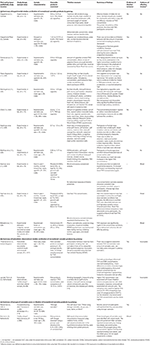
Table one. Summary of experimental (a), observational (b), and survey (c) studies on titration of recreational cannabis products by potency.
Narrative Review
Experimental Laboratory Studies
In that location was mixed evidence of titration in experimental studies that were conducted in the 70–90's (5, 6, 12–17). These studies used various methods to measure out dose titration (e.g., measuring the total corporeality of THC that was self-administered and assessing the physiological, and psychological effects of the cannabis consumed).
Some of these studies reported differences in smoking topography, such every bit taking smaller puffs, smaller inhalation volumes, shorter puff duration, longer inter-puff intervals, when using more potent cannabis products (6, 13, 16). Other studies did not (five, 12, 15). The participants in the higher dose atmospheric condition in all studies consumed more THC and reported more psychoactive effects, regardless of adjustments in their smoking behavior.
More recent studies have establish some evidence of titration. Hartman et al. conducted an experimental study that evaluated the cannabinoid levels in blood and plasma later on the use of vaporized cannabis that varied THC content, with and without alcohol consumption, while assuasive advertising-libitum consumption (9, 10). They recruited 32 participants who had used cannabis in the past iii months no more than than three times a week. Nineteen (59%) completed all the sessions and provided data on cannabinoid levels in blood and plasma concentrations (10) and oral fluid (9). Participants inhaled vaporized cannabis (ground cannabis obtained through NIDA) ad-libitum for ten min. The THC levels were 0.008% in the placebo, 2.ix% in the low and 6.7% in the loftier concentration cannabis atmospheric condition. Participants consumed the three cannabis products with and without a concurrent low-dose alcoholic beverage, across six testing sessions.
In the analyses of blood and plasma THC concentrations (10) ten of the xix participants showed evidence of dose titration as indexed by maximum blood THC concentration (μg/L). Specifically, iv participants had THC concentrations for the low and high concentration atmospheric condition were within twenty% of each other, and six participants had greater THC concentrations in the low than the high cannabis condition. Sessions using low concentration cannabis produced consistent THC blood max concentration and AUC values whereas higher dose products did not. This suggests that users attempted to titrate their dose. Data were not presented separately for booze and no booze conditions, merely there were no significant interactions between cannabis dose and alcohol consumption in their effects on THC concentration or AUC.
Bidwell et al. (11) reported a between-subjects experimental written report in cannabis users who predominantly used flower/concentrates. They measured blood levels of cannabinoids and the active THC metabolite 11-hydroxyΔ9-THC (11-OH-THC) and assessed subjective intoxication and mood, and performance on memory, inhibitory control, and balance. Participants were randomly assigned to smoke cannabis products of their preferred type that were standardized to contain either low (flower: 16%; concentrate: lxx%) or high (blossom 24%, concentrate 90%) THC concentrations.
Claret THC and THC metabolite levels differed between the two forms of cannabis, with concentrates producing higher blood levels than flower (eleven). There was no significant difference in levels between the two potency levels for cannabis concentrate (70 vs. xc% THC). For cannabis flower, the difference in blood levels approached the pre-specified significance threshold of p < 0.01 for claret THC (p = 0.01) and xi-OH-THC (p = 0.02). Although this issue was non nominally pregnant, it suggested that participants who predominantly used flower experienced more difficulty adjusting their THC intake.
Concentrate users accomplished more than double the mean blood THC level of flower users (11). Despite this difference, self-reported measures of intoxication did not differ betwixt users of the two products. The reason for this discrepancy is unclear. Possible explanations include increased tolerance to THC in concentrate users, a saturation of the cannabinoid receptors and so that additional THC intake no longer produced an effect, or differences in user characteristics that touch on metabolism/sensitivity to THC. Potency did not significantly bear upon any of the neurobehavioral measures.
Observational Studies
Observational studies of cannabis users' behavior when using cannabis that varied in say-so take shown mixed evidence of titration (ii, 4).
Freeman et al. (iv) reported an observational study in the United kingdom of great britain and northern ireland in which participants used their own cannabis that chemical analyses had established varied in authority and type (skunk, resin, and herbal). Participants were asked to roll a articulation and smoke it usually while the researcher recorded their cocky-reported subjective intoxication and assessed their verbal IQ using the Wechsler Test of Adult Reading.
The study found a negative relationship betwixt THC concentration of the cannabis and the amount of cannabis added to their joints. This relationship was not influenced by the users' frequency of utilise. The THC levels of the cannabis products were positively correlated with participants' estimation of their potency but the correlation was low. The amount of cannabis consumed was not influenced by product type/potency and participants did not differ in their subjective levels of intoxication.
A like study in the Netherlands by van der Politician et al. found mixed testify on whether experienced cannabis users could successfully titrate their THC doses (2). This was a naturalistic, observational written report of young experienced cannabis users recruited through "java-shops" and chain referrals. The participants used their ain cannabis products that varied in THC concentration. Smoking topography was measured using a portable device to appraise puff book, duration, inter-puff interval, average velocity (ml/south), peak flow (ml/s), and time to top puff velocity (ml).
van der Pol et al. (ii) establish a positive association between cannabis THC concentration and the amount of cannabis consumed (i.e., participants who used more than stiff cannabis used larger amounts in their regular joints). In that location was, nonetheless, a negative association between THC concentration of joints and total inhaled smoke volume. This indicated that users inhaled less cannabis smoke when using cannabis with higher THC concentrations. Despite this, they consumed larger amounts when using high authorisation cannabis. This suggests that their attempt to titrate their doses was but partially successful as measured past THC in blood plasma.
Surveys of Cannabis Users' Behavior
A survey comparison patterns of cannabis use in San Francisco and Amsterdam is oft cited as prove for titration (8). In this written report cannabis users were asked: "When using stronger cannabis, do you apply less, same, or more?" I-3rd of respondents reported that they used the same corporeality, and two-thirds reported that they used less. Those who reported smoking less of "stronger cannabis" said that they preferred to achieve the same effect past using less cannabis. This study tin can exist considered as hypothesis-generating, because it did non employ puff topography or measure out THC.
Korf et al. (7) conducted a survey of Netherlands "java-shop" patrons who used cannabis and hash products that varied in potency. They collected data on self-reported behavior when smoking more potent cannabis products and identified three groups of users. The offset group that varied in historic period and sex and preferred to utilize milder cannabis reported inhaling less deeply and smoking smaller amounts of higher authority cannabis. The second was a younger grouping with more symptoms of cannabis dependence who reported that they inhaled more potent products more than deeply. The third comprised older predominantly males with long cannabis careers who lived and smoked alone. They did not study whatsoever adjustments in smoking behavior when they used more potent cannabis.
Discussion
This review plant mixed testify on how successful cannabis users were in adjusting their dose of more stiff cannabis to achieve the aforementioned delivery of THC or the aforementioned desired psychoactive furnishings. Older experimental studies found little prove for titration simply often used cannabis with much lower THC levels that differed minimally between weather condition. More recent experimental studies of ad-libitum cannabis provided some evidence of titration past finding reductions in the amount of THC in claret and plasma when products of different potency were used. An experimental study of controlled cannabis vaporization found like THC concentrations in claret in the depression and loftier dose THC conditions in some, but non all, participants. This provides some support that some cannabis users titrate their THC dose during advertizement-libitum consumption (9, x).
Observational studies establish weak evidence that cannabis smokers reduced their THC doses when using cannabis products with college levels of THC. In surveys, there were self-reported changes in cannabis use but no assessments were made of whether these produced differences in the THC dose consumed or in its physiological or psychological effects.
The question of nigh relevance to cannabis policy is whether the users of higher THC products do, in fact, titrate their doses. Epidemiological surveys of adverse furnishings reported by cannabis users propose that users of more potent cannabis products incompletely adjust their THC doses. In these surveys, consumers of higher THC cannabis products study more negative consequences than users of less stiff products (eighteen, xix). A UK cohort study showed that users of loftier dominance cannabis had higher risks of generalized anxiety and cannabis use disorders (20).
There are supportive trends in ecological information. In the USA emergency, hospital, and poisoning heart presentations related to cannabis have increased along with the increased apply of high THC cannabis products subsequently cannabis legalization (21). In kingdom of the netherlands, in that location was an increase in the number of persons seeking help to quit cannabis equally the average THC content of cannabis sold in coffee shops increased and a afterward fall in numbers when THC content declined (three).
Limitations of the Show
This review was severely limited past the dearth of rigorous studies on whether people who use cannabis can effectively titrate their doses of higher say-so cannabis. The recent rapid increase in THC authorisation in cannabis products on the market makes it difficult to compare the findings of early on studies that used very low THC cannabis products by comparison with cannabis products now consumed.
There may besides have been changes over time in the characteristics of people who use cannabis and in their frequency of use. Tolerance develops with the frequency of cannabis intake so cannabis effects will differ between the occasional users oftentimes studied in laboratories and the daily cannabis users who account for most of the cannabis consumed (22).
Routes of assistants have also inverse over fourth dimension. Although we did not restrict our search to studies of any specific road of administrations, all the studies we included were of inhaled cannabis products. Methods and ease of titration between dissimilar routes of cannabis administration may vary. Vaporization and smoking provide like cannabinoid delivery (23), merely the subjective effects of edible products have a longer time class and users may be at risk of consuming more than intended if they had not waited for them to take effect before deciding to eat more. There are doubts nearly how well users can titrate their THC doses of oral cannabis products, given that individuals may not know how long they need to wait to assess whether they have reached their desired level of intoxication. Future studies are needed on cocky-titration of cannabis use by new and emerging administration methods.
Some early laboratory studies of cannabis consumption assessed the human relationship betwixt blood concentrations of THC and the furnishings of cannabis (24). Still, many surveys accept only assessed titration past self-study rather than measuring the THC content of cannabis or the level of users' intoxication. Self-reported titration tin can be subject to selective reporting, retention furnishings and bias and hence provides weak show for the titration.
Smoking topography was measured in some studies, with some authors arguing that it is difficult to assess titration without these measures (xvi). The use of behavioral endpoints as measures is problematic considering frequent users have higher tolerance. Objective measures of cannabis potency and THC exposure, such as assessing THC concentration in blood and plasma in laboratory settings, are required in future enquiry on cannabis dose titration.
This review was restricted to papers written in English. The predominance of studies from North America may limit the generalisability of these results. The marketing of loftier THC content products in the USA may have global impacts as online markets are increasingly pop and merchants accessible through online crypto-markets in the USA are prepared to ship cannabis products worldwide (25).
Our review excluded studies of cannabis when used to alleviate symptoms of chronic medical or mental wellness atmospheric condition. Future research is needed that monitors the prevalence of medical use and assesses the extent to which medicinal cannabis users titrate their doses.
There is an urgent need for larger and amend controlled experimental and observational studies of the extent to which cannabis users can and do titrate their THC doses when using more than potent cannabis products, such as, cannabis extracts and high authority cannabis flower. This inquiry is needed to inform policymakers on how to reduce harms from the use of loftier potency cannabis products. It may indicate the need for caps on the authority of cannabis products or college taxes on more potent cannabis products to discourage their heavy use (26). It is as well needed to inform the labeling of THC doses in legal cannabis products that may include standardized THC doses coordinating to standard units of alcohol (27).
Author Contributions
WH and JL: design and conception. JL, DS, and DD: acquisition and analysis of data. JL and DD: first draft. All authors: interpretation of data, subsequent drafts, revision for important intellectual content, last blessing, and agreement to be accountable for the piece of work.
Funding
JL was supported by the University of Queensland Development Fellowship (1833885).
Conflict of Interest
The authors declare that the inquiry was conducted in the absenteeism of any commercial or financial relationships that could be construed as a potential conflict of involvement.
Acknowledgments
We would like to acknowledge the assistance of librarian Miranda Newell, The University of Queensland, for her aid with the search.
Supplementary Material
The Supplementary Fabric for this article can exist institute online at: https://world wide web.frontiersin.org/articles/10.3389/fpsyt.2021.630602/total#supplementary-fabric
References
1. Hall W, Stjepanović D, Caulkins J, Lynskey M, Leung J, Campbell G, et al. Public wellness implications of legalising the product and auction of cannabis for medicinal and recreational use. Lancet. (2019) 394:1580–90. doi: 10.1016/S0140-6736(nineteen)31789-1
PubMed Abstract | CrossRef Total Text | Google Scholar
ii. Van Der Pol P, Liebregts Due north, Burden T, Van Amsterdam J, De Graaf R, Korf DJ, et al. Cross-sectional and prospective relation of cannabis potency, dosing and smoking behaviour with cannabis dependence: an ecological study. Addiction. (2014) 109:1101–9. doi: 10.1111/add.12508
PubMed Abstract | CrossRef Full Text | Google Scholar
iii. Freeman TP, Van Der Pol P, Kuijpers W, Wisselink J, Das RK, Rigter S, et al. Changes in cannabis potency and first-fourth dimension admissions to drug handling: a 16-year report in the netherlands. Psychol Med. (2018) 48:2346–52. doi: ten.1017/S0033291717003877
PubMed Abstract | CrossRef Full Text | Google Scholar
four. Freeman TP, Morgan CJ, Hindocha C, Schafer Thou, Das RK, Curran HV. Just say "know:" how do cannabinoid concentrations influence users' estimates of cannabis potency and the amount they scroll in joints? Addiction. (2014) 109:1686–94. doi: ten.1111/add.12634
PubMed Abstract | CrossRef Full Text | Google Scholar
5. Cappell H, Kuchar Eastward, Webster CD. Some correlates of marihuana self-assistants in man: a study of titration of intake as a part of drug potency. Psychopharmacologia. (1973) 29:177–84. doi: 10.1007/BF00414031
PubMed Abstruse | CrossRef Full Text | Google Scholar
six. Cappell H, Pliner P. Regulation of the self administration of marihuana by psychological and pharmacological variables. Psychopharmacologia. (1974) forty:65–76. doi: 10.1007/BF00429448
PubMed Abstract | CrossRef Full Text | Google Scholar
seven. Korf DJ, Benschop A, Wouters M. Differential responses to cannabis potency: a typology of users based on cocky-reported consumption behaviour. Int J Drug Policy. (2007) eighteen:168–76. doi: ten.1016/j.drugpo.2006.08.002
PubMed Abstract | CrossRef Full Text | Google Scholar
8. Reinarman C. Cannabis policies and user practices: market separation, price, potency, and accessibility in Amsterdam and San Francisco. Int J Drug Policy. (2009) twenty:28–37. doi: ten.1016/j.drugpo.2007.11.003
PubMed Abstract | CrossRef Full Text | Google Scholar
ix. Hartman RL, Anizan S, Jang M, Brown TL, Yun Thou, Gorelick DA, et al. Cannabinoid disposition in oral fluid afterward controlled vaporizer assistants with and without alcohol. Forensic Toxicol. (2015) 33:260–78. doi: ten.1007/s11419-015-0269-6
CrossRef Full Text | Google Scholar
10. Hartman RL, Dark-brown TL, Milavetz G, Spurgin A, Gorelick DA, Gaffney G, et al. Controlled cannabis vaporizer administration: claret and plasma cannabinoids with and without alcohol. Clin Chem. (2015) 61:850–69. doi: 10.1373/clinchem.2015.238287
PubMed Abstract | CrossRef Total Text | Google Scholar
11. Bidwell LC, Ellingson JM, Karoly HC, Yorkwilliams SL, Hitchcock LN, Tracy BL, et al. Clan of naturalistic assistants of cannabis blossom and concentrates with intoxication and impairment. JAMA Psychiatry. (2020) 77:787–96. doi: 10.1001/jamapsychiatry.2020.0927
PubMed Abstract | CrossRef Full Text | Google Scholar
12. Domino EF, Rennick P, Pearl JH. Dose consequence relations of marijuana smoking on diverse physiological parameters in experienced male users. Observations on limits of self titration of intake. Clin Pharmacol Therapeut. (1974) 15:514–20. doi: 10.1002/cpt1974155514
PubMed Abstract | CrossRef Full Text | Google Scholar
thirteen. Perez-Reyes M, Di Guiseppi S, Davis KH, Schindler VH, Melt CE. Comparison of effects of marihuana cigarettes to 3 different potencies. Clin Pharmacol Ther. (1982) 31:617–24. doi: 10.1038/clpt.1982.86
PubMed Abstract | CrossRef Full Text | Google Scholar
16. Heishman SJ, Stitzer ML, Yingling JE. Furnishings of tetrahydrocannabinol content on marijuana smoking beliefs, subjective reports, and performance. Pharmacol Biochem Behav. (1989) 34:173–9. doi: 10.1016/0091-3057(89)90369-9
PubMed Abstract | CrossRef Total Text | Google Scholar
17. Matthias P, Tashkin DP, Marques-Magallanes JA, Wilkins JN, Simmons MS. Effects of varying marijuana potency on deposition of tar and delta9-THC in the lung during smoking. Pharmacol Biochem Behav. (1997) 58:1145–50. doi: 10.1016/S0091-3057(97)00328-half-dozen
PubMed Abstract | CrossRef Full Text | Google Scholar
xviii. Freeman TP, Winstock AR. Examining the profile of high-authority cannabis and its association with severity of cannabis dependence. Psychol Med. (2015) 45:3181–9. doi: 10.1017/S0033291715001178
PubMed Abstract | CrossRef Full Text | Google Scholar
19. Chan GCK, Hall W, Freeman TP, Ferris J, Kelly AB, Winstock A. User characteristics and effect profile of Butane Hash Oil: an extremely high-potency cannabis concentrate. Drug Alcohol Depend. (2017) 178:32–8. doi: 10.1016/j.drugalcdep.2017.04.014
PubMed Abstract | CrossRef Full Text | Google Scholar
twenty. Hines LA, Freeman TP, Gage SH, Zammit S, Hickman One thousand, Cannon Thou, et al. Clan of high-potency cannabis use with mental health and substance use in adolescence. JAMA Psychiatry. (2020) 77:1044–51. doi: 10.1001/jamapsychiatry.2020.1035
PubMed Abstruse | CrossRef Total Text | Google Scholar
21. Leung J, Chiu V, Chan GCK, Stjepanović D, Hall WD. What have been the public health impacts of cannabis legalisation in the USA? A review of evidence on adverse and beneficial effects. Curr Addict Rep. (2019) 6:418–28. doi: ten.1007/s40429-019-00291-x
CrossRef Full Text | Google Scholar
22. Chan GCK, Hall Due west. Estimation of the proportion of population cannabis consumption in Australia that is deemed for by daily users using Monte Carlo Simulation. Addiction. (2020) 115:1182–half-dozen. doi: 10.1111/add.14909
PubMed Abstract | CrossRef Total Text | Google Scholar
23. Newmeyer MN, Swortwood MJ, Barnes AJ, Abulseoud OA, Scheidweiler KB, Huestis MA. Free and glucuronide whole blood cannabinoids' pharmacokinetics after controlled smoked, vaporized, and oral cannabis administration in frequent and occasional cannabis users: identification of recent cannabis intake. Clin Chem. (2016) 62:1579–92. doi: x.1373/clinchem.2016.263475
PubMed Abstruse | CrossRef Full Text | Google Scholar
24. Cone EJ, Huestis MA. Relating blood concentrations of tetrahydrocannabinol and metabolites to pharmacologic furnishings and time of marijuana usage. Ther Drug Monit. (1993) 15:527–32. doi: x.1097/00007691-199312000-00013
PubMed Abstract | CrossRef Total Text | Google Scholar
25. Lim CCW, Leung JKY, Connor JP, Hall WD, Gartner C, Cheng BHC, et al. Availability of substances for use in personal vaporisers on three online cryptomarkets. Drug Alcohol Dependence. (2020) 217:108254. doi: 10.1016/j.drugalcdep.2020.108254
PubMed Abstract | CrossRef Total Text | Google Scholar
27. Freeman TP, Lorenzetti V. "Standard THC units:" a proposal to standardize dose beyond all cannabis products and methods of administration. Addiction. (2020) 115:1207–16. doi: 10.1111/add together.14842
PubMed Abstract | CrossRef Full Text | Google Scholar
burchetthimmenting.blogspot.com
Source: https://www.frontiersin.org/articles/10.3389/fpsyt.2021.630602/full
0 Response to "In Certain Cannabis Products, Thc Concentrations Can Be How High?"
Post a Comment